Ways Hamlet has been read through time: There is a number of ways that Hamlet has been read throughout time. The main styles of interpreting the play are Dominant, Feminist, Freudian/Psychoanalytical and Marxist. It is important to recognise that Hamlet has been perceived differently over time. Hamlet was seen to have somewhat of a different meaning in the 16th century when the Monarchy was thought to be the level below God in the chain of being | 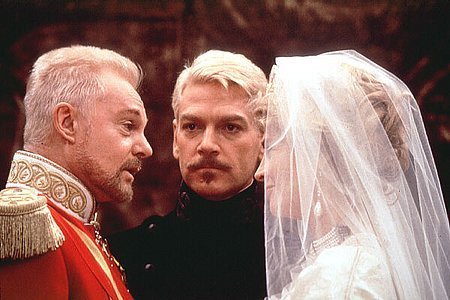 |
Dominant -
A dominant reading is the most obvious or literal way of reading the text. Unlike other styles of reading, dominant reading is not biased in any way. This style of reading interprets the dominant stereotypes present in the society to which it belongs. Being the stereotypical way that Hamlet would be read, most points of a Dominant styled reading are obvious. Even though Hamlet Is questionably insane, it is easier to see the personality and place in the play of other character such as Horatio, Polonius and Claudius under a dominant reading.
Feminist -
A feminist reading focuses on how women are represented in the text, and their relationship that they have to the men that are also in the text. Since the 1970’s, when there was a lot of discussion about whether women had equal rights or not, this brought upon the feminist style of reading. The feminist way of reading Hamlet mainly focuses on how Ophelia and Gertrude are not portrayed in the same way that men are in the play. For example at the end when Horatio speaks for Hamlet, many feminist critics believe that the death of Gertrude and Ophelia were not portrayed in an influential way. It is assumed by many feminist critics that Ophelia represents the oppression of women throughout time, which is seen to be accentuated by the way Hamlet treats her and talks to her, especially the use of the words “frailty and obey” suggesting that women are weak and must follow a man’s instructions. Gertrude has been represented in a number of ways throughout time, in some versions of the play she is represented as weak, irresponsible or guilty of her hasty marriage.
Freudian/Psychoanalytical -
this style of reading focuses on how the emotions and thoughts of the character come out due to their past experiences that have been repressed. This style of reading may focus on the author’s needs and desires. William Shakespeare focuses deeply on Hamlet’s emotional side and his complex way of thinking. It is evident throughout the play that Hamlet is confused but highly educated in his ways of thinking, being able to rationalise most of his actions. Hamlet could have killed Claudius whilst he was praying, but decided not to as this would not fully portray Claudius’ guilt. Critics such as Richard Finklestein who wrote “Differentiating Hamlet: Ophelia and the Problems of Subjectivity” and John Russel who wrote “Hamlet and Narcissus” have both made important comments on Hamlet and the Freudian style of reading. Finklestein connects a Freudian style of reading to a feminist, believing that Hamlet chooses to use his education to manipulate Ophelia. Russel writes about Hamlet’s behaviour which is the result of that most characteristic pre-Oedipal strategy of defence and states that Hamlets “commitment finally is not to reality but to the distortions of narcissistic fantasy”.
Marxist -
A Marxist way of reading a text focuses on how influential the text may be when its values and beliefs are explored. A Marxist reading will evaluate how society is represented in the text and will mean that the reader is focused on how there may be social or power differences between the characters. It is apparent that Hamlet takes place against two backdrops. One being international politics, showing how diplomatic missions may affect a whole country or the people in power and the other backdrop being the personal struggle of Hamlet as well as the relationship between the Royals and the courtiers and the power difference between them even though they appear to be close in friendship.
What is the historical value of Hamlet now and for future generations?
Hamlet is a very important fictional and historical text, written by arguably the greatest play write the world has seen. Its importance for future generations cannot be defined by certain levels of measurement. Hamlet does, however, provide an important statement about family, friendship, status quo and mankind in general. Shakespeare raises many questions about life and death as well as other important issues. For example Hamlet’s “to be or not to be” soliloquy is about whether or not it is worth living, and is one of the most famous quotes in history. The text is thought provoking and readily translates to today’s issues and it is likely that it will be influential in the future. It also provides a historical snapshot of life around the early 17th century.
